A Fleadh Cheoil is one of those events that sounds straightforward until you actually arrive and realise there is a lot more going on than you expected. Music, yes, but also parades, street sessions, competitions, dancing in car parks, queues for chips at midnight, and the particular electric feeling of a whole town given over entirely to one purpose. If you have never been, it can feel a little overwhelming to know where to even start.
This is meant to help with that.
What actually happens at a Fleadh
The Fleadh Cheoil is an Irish traditional music festival organised by Comhaltas Ceoltóirí Éireann. There are county and provincial fleadhanna happening throughout the summer all over Ireland, and then there is Fleadh Cheoil na hÉireann, the national one, which rotates between towns and regularly draws somewhere in the region of several hundred thousand visitors across the week. It is genuinely massive.
The formal part of the festival is a competition. Musicians, singers, and dancers of all ages come to compete in categories ranging from solo instruments to céilí bands, with the best at each level working their way up from county level. These competitions happen in halls and venues around the host town, and you can usually attend many of them as a spectator without paying anything. Watching a junior tin whistle competition, with small children absolutely nailing reels in front of a panel of judges, is quietly one of the most charming things the week has to offer.
But a lot of people who attend never go near a competition at all. They come for the sessions.
The sessions: what to expect
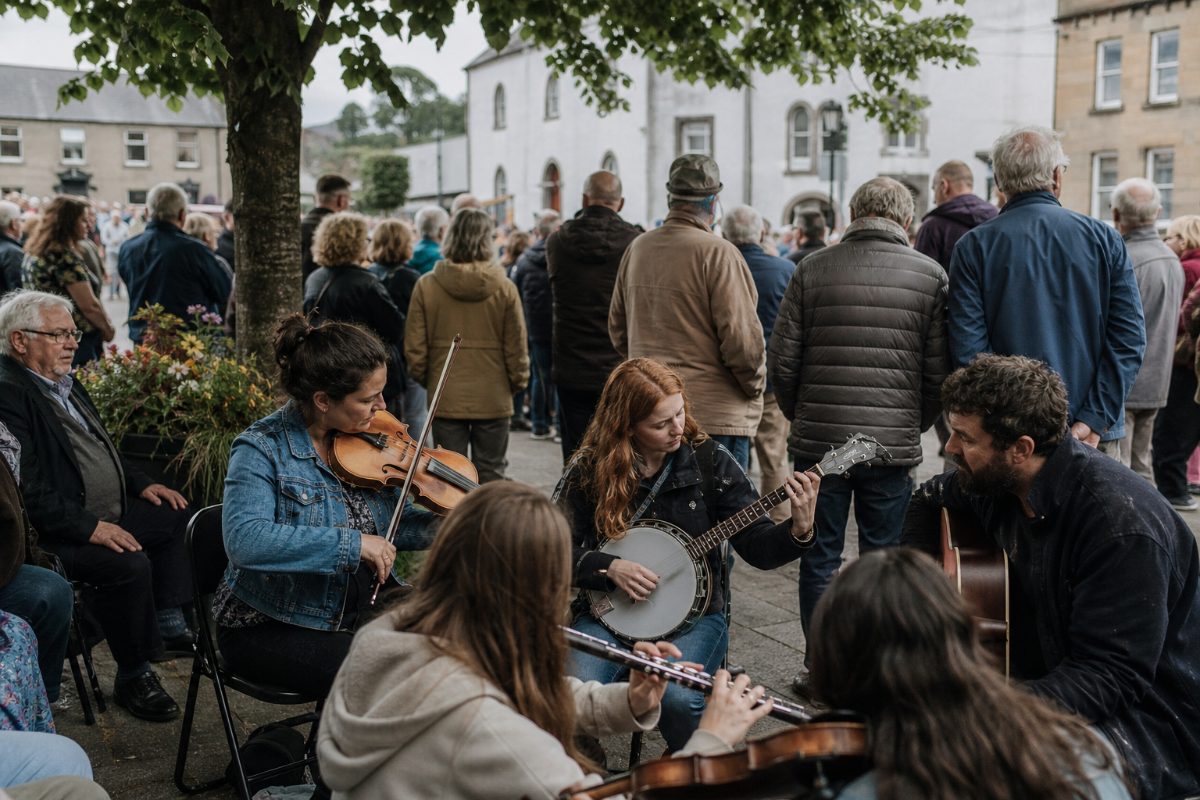
A session, in the traditional music sense, is an informal gathering of musicians playing together, usually in a pub or on the street. During a Fleadh, sessions are absolutely everywhere. They spill out of pub doors, they form spontaneously on footpaths, they carry on until the small hours. You will round a corner and find twenty people sitting on the kerb playing fiddles and flutes, with a crowd three deep watching and nodding along.
As a first-timer, the most important thing to understand is that sessions are not performances in the conventional sense. The musicians are playing for themselves as much as for anyone else. Applause between tunes is fine and welcome, but do not talk loudly over the music, do not request specific songs (especially not Galway Girl), and if you are standing in a pub session, give the musicians their space. Crowding in too close or leaning over someone mid-tune is the kind of thing that will earn you a look.
If you play an instrument yourself, you are generally welcome to join a session, but read the room first. A session of experienced players setting a fast pace is not the place to be nervously fumbling through your first reel. Smaller, more relaxed gatherings are much better for sitting in.
Finding your way around the town
The host town during Fleadh week is genuinely transformed. Streets are closed to traffic, stages go up, and every available pub, hall, and community space becomes a venue. Pick up a programme when you arrive, because the official schedule of competitions and ticketed events will be printed there, and it helps to have a rough sense of what is happening where.
That said, some of the best moments happen completely off-schedule. Walk around. Follow the sound of music. The street sessions in particular can be extraordinary, and they cost nothing to stand and listen to for as long as you like.
Practical things worth knowing: bring cash, because smaller traders and some venues still prefer it. Wear comfortable shoes because you will cover a lot of ground. If you are bringing children, mornings and early afternoons tend to be quieter and easier to manage. Evenings get loud, crowded, and very much adult-oriented in the pubs, though the streets themselves stay lively and mixed well into the night.
A few things that catch first-timers off guard
The sheer scale surprises most people. Even at a provincial fleadh, the volume of musicians and visitors fills a town in a way that feels almost surreal if you have not seen it before.
The weather is, as ever, its own variable. Bring a layer regardless of the forecast. Standing listening to a session on a street corner at nine in the evening with a bit of a breeze coming in is significantly more enjoyable if you are not shivering.
Accommodation books out very early, sometimes almost a year ahead for the national event. If you are thinking about staying over rather than day-tripping, sort that side of things well in advance. The practical groundwork you put into planning a full day out at a big event applies here too, maybe even more so when the event runs across an entire week and an entire town.
Go at least once. It is one of those things that is genuinely hard to describe until you have stood in the middle of it yourself.