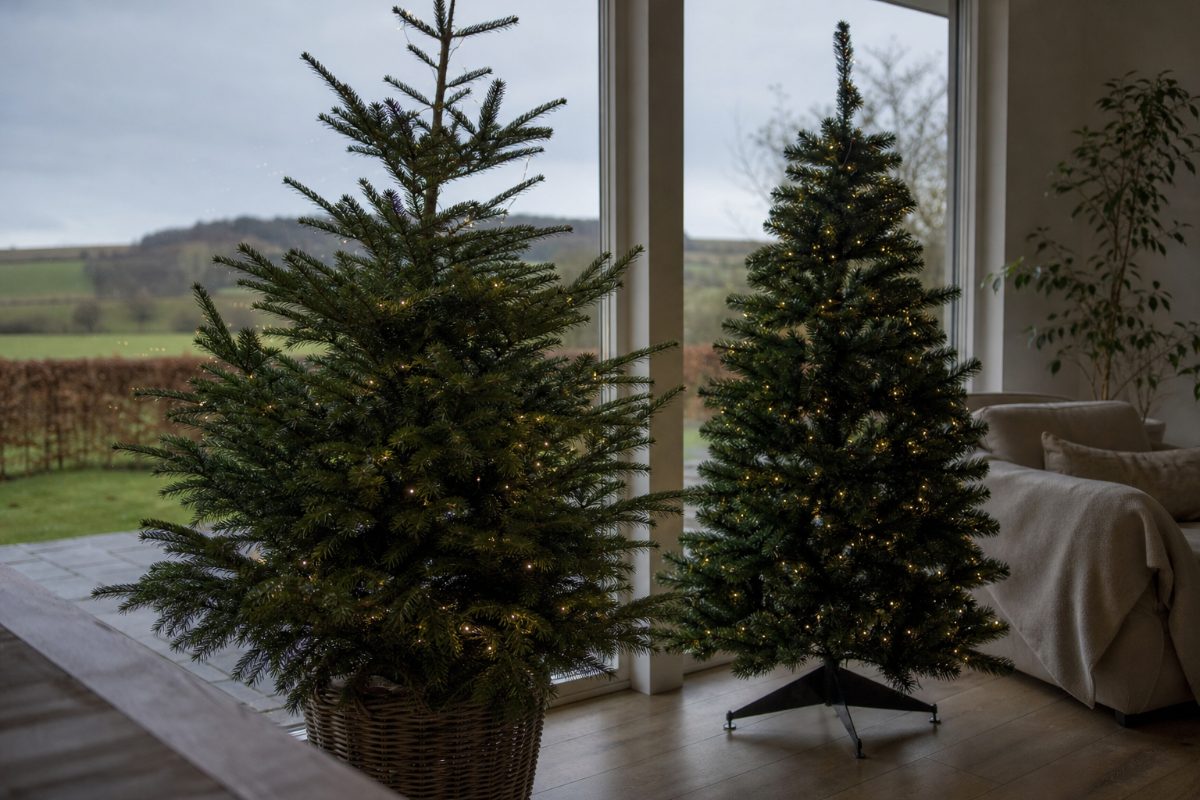
Every December, the same conversation starts up in households across the country. Real or artificial? It sounds like a small decision but it carries a surprising amount of weight, financially, environmentally, and emotionally. There is no single right answer, and anyone who tells you otherwise is probably trying to sell you something.
Here is an honest look at both sides, with the Irish context in mind.
The case for a real tree
There is something about a real tree that an artificial one cannot fully replicate. The smell alone is worth the price for a lot of people. That fresh, resinous scent when you bring it through the front door is part of what makes the house feel like Christmas has actually arrived, not just been installed.
In Ireland, real Christmas trees are widely available from late November. You will find them at garden centres, farm shops, local markets, and roadside sellers who appear reliably every year at the same roundabout or car park. Most are Nordmann firs, which hold their needles well and stay looking good well into January. Norway spruces are cheaper but they shed needles faster and you will be hoovering them out of the carpet until March.
From an environmental standpoint, a real tree grown in Ireland is not the disaster it is sometimes made out to be. Trees absorb carbon while they are growing, and Irish-grown trees support local farm businesses. The key question is what happens after Christmas. If your local council collects trees for composting or chipping, the environmental cost is quite low. Many councils do run this service in early January, so it is worth checking your local authority's website before the holiday. The Environmental Protection Agency has guidance on how different tree materials and disposal methods compare, which is useful if you want to look at the broader picture.
The obvious downside of a real tree is the annual cost. A decent-sized Nordmann fir will run you somewhere between 40 and 80 euro in most parts of the country, sometimes more in Dublin. That adds up quickly if you are buying one every year for twenty years. And the mess is real. Needles everywhere, the awkward business of getting the stand to hold the tree upright, the drive to the recycling centre if your council does not collect. Some years it all feels like a lot of effort.
The case for an artificial tree
Artificial trees have improved enormously. The flimsy silver things of the 1980s are long gone. A good quality artificial tree looks convincing, comes pre-lit in many cases, and can be stored and reused for ten or fifteen years. If you spend 150 euro on a tree and use it for twelve years, you are paying about 12 euro a year. The economics are genuinely hard to argue with.
They are also easier for people who cannot easily get to a garden centre, or who live in apartments without a car, or who have allergies to pine. No mess, no watering, no emergency runs for a new stand. You take it out of the attic, put it up, and it looks exactly the same as it did last year.
The environmental picture is more complicated, though. Most artificial trees are made from PVC, a plastic that does not break down easily and that carries a significant manufacturing footprint. The majority are made in China and shipped here, which adds to that cost. The general rule of thumb is that you need to use an artificial tree for at least ten years before it starts to look better than buying real trees annually. Some households manage that easily. Others buy a new artificial tree every five or six years when they want a change, and at that point the environmental case falls apart.
There is also the question of what happens to the tree at the end of its life. PVC trees cannot be recycled in most household schemes and typically end up in landfill. That is worth thinking about before you buy.
What actually matters for most families
Honestly, the sentimental side of this decision probably outweighs the practical side for most people. If your family has always had a real tree, the smell and the ritual of choosing it are part of Christmas in a way that is hard to let go of. If you grew up with an artificial tree and associate that with warmth and familiarity, switching to real is not some obvious upgrade.
Some families do both: a real tree in the main room, a small artificial one in the kids' bedroom or the hall. That is more common than people admit.
The traditions that gather around the tree, the decorating, the candle in the window on Christmas Eve, the whole atmosphere of the season, matter far more than what the tree is made of. Buy the one that fits your budget, your circumstances, and your version of Christmas. That is the right answer.